Verbal Intelligence Test β Free Online Practice, Solved MCQs & PDF (Updated 2026)
For candidates preparing for ISSB, PMA, Pakistan Navy, PAF, and AFNS initial tests β practice real verbal intelligence test questions online, see exactly how the test is timed, and download free MCQs to study offline.
What Is a Verbal Intelligence Test?
Verbal intelligence is your ability to solve logical mind puzzles using words instead of numbers or shapes. It involves finding relationships between words, completing word sequences, and understanding language quickly under a strict timer. A verbal intelligence test measures this directly through multiple-choice questions (MCQs): analogies (word relationship puzzles), word and letter series, odd-one-out, coding-decoding, and jumbled spelling.
It is not an English test. You are not scored on your grammar or essay writing; you are scored on how fast and accurately you can spot a pattern in words, numbers, or letters and solve it. This difference is important because candidates who assume “verbal” means “vocabulary” often under-prepare for the pattern-recognition side of the paper.
In Pakistan, the verbal intelligence test is a standard part of the initial computer test for the armed forces and allied services: ISSB, PMA Long Course, LCC, Pakistan Navy, PAF, and AFNS all use some version of it, usually paired with a non-verbal intelligence test and a verbal reasoning test in the same sitting. See our full breakdown of verbal vs. non-verbal intelligence tests if you want the side-by-side comparison (direct comparison).
In psychology, verbal intelligence is treated as one part of general intelligence alongside spatial (shapes and patterns), numerical (math and numbers), and non-verbal reasoning. This is why these tests are used for military selection, academic aptitude tests, and job hiring.
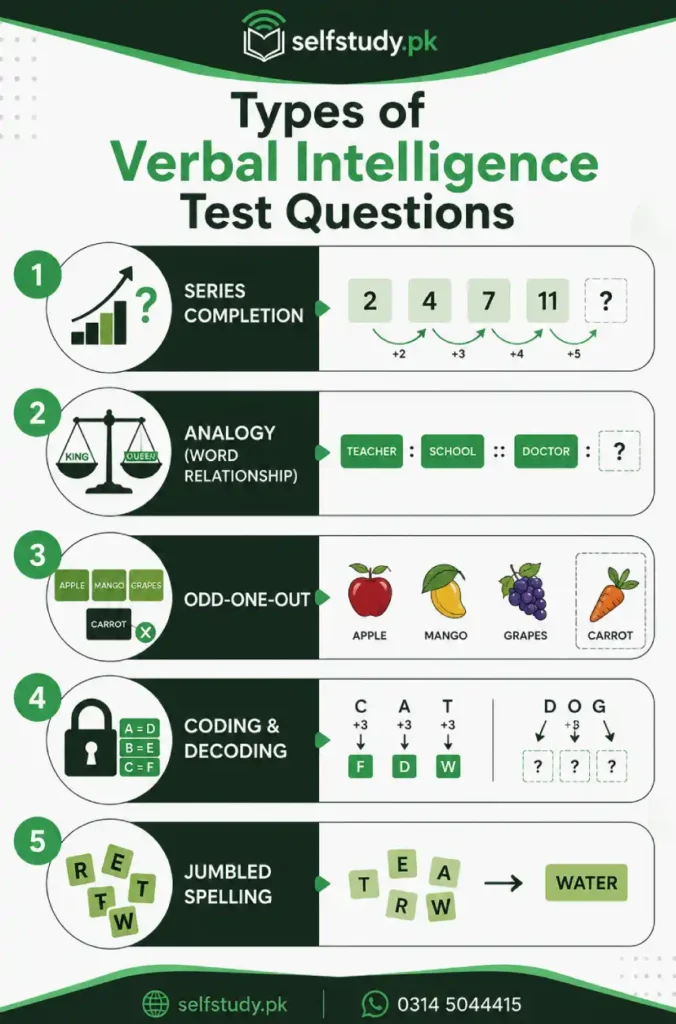
Types of Verbal Intelligence Test Questions
Every verbal intelligence test draws from the same handful of question types. Knowing these category names in advance helps you quickly recognize what each question is asking and solve it faster.
1. Series Completion
You are given a sequence (line) of numbers or letters with one or more missing parts, and you have to find the pattern to fill the gap. Patterns can range from simple addition or subtraction to alternating steps or squared and prime-number sequences.
2. Analogy (Word Relationship) Questions
You are given a pair of words that are related in a specific way, and you must find a second pair with the exact same relationship. This tests whether you can spot how two words connect, not just what they mean individually.
3. Odd-One-Out
Given a group of words or terms, you must find which one does not belong with the rest. This tests classification (sorting into groups) and pattern recognition rather than vocabulary size.
4. Coding and Decoding
Words or letters are converted into a secret code using a set rule (like shifting letters forward or replacing them with numbers). You must crack the rule to decode or write a new term.
5. Jumbled Spelling
The letters of a real word are scrambled, and you must unscramble them back into the correct word under a strict timer. This tests how quickly your brain recognizes letter patterns.
Test Format: Timing, Pace, and the Pass/Fail Rule
This is the part most test guides skip, but it decides whether you pass or fail.
Total Timer, Not Per Question
Across initial tests, your target pace is ~20 seconds per question. Spending 30+ seconds on a single question wastes precious time needed for the rest of the paper.
Each Section Is a Separate Gate
Sections are taken sequentially. On tests like AFNS, failing the verbal section stops your test immediatelyβending your attempt before you reach your strongest subjects.
Speed Over Deep Knowledge
Most candidates fail due to poor time management, not tough questions. Practicing without a running clock at home won't prepare you for exam day pressure.
Initial Test Timings & Question Counts
Target pace and structure across military branch computer-based tests.
PMA Long Course
PAF
Pakistan Navy (SSC & Sailor)
AFNS
Solved Sample Questions With Answers
Step-by-step breakdowns of core verbal intelligence question types.
What comes next in the series: 2, 6, 12, 20, 30, ?
Pen is to Write as Knife is to ___?
Which one does not belong: Apple, Banana, Carrot, Mango?
If CAT is coded as DBU, how is DOG coded?
Rearrange the letters "TAEGR" to form a meaningful word.
Free Verbal Intelligence Test PDF
Want to practice offline or without an internet connection on test day minus one? Download the free verbal intelligence test PDF below β it covers all the question types explained above with answers included.
Practice Online: Analogy & Series MCQ Tests
Every quiz below is free, scored instantly, and built from the same question types explained above. Work through them in order if you’re new to this, or jump straight to your weak category if you already know where you’re losing marks.
Prefer pattern-recognition and shape-based questions instead? Practice the non-verbal intelligence test separately, or see how the two compare on our verbal vs. non-verbal intelligence test guide.
β‘ Master the patterns on paper before taking our live timed tests online:
One failed test delays your career by 6 months. Secure your recommended status with original, updated exam guides.
Super Excellent Intelligence Test Guide by Dogar Publishers (Latest Edition)
Essential for ISSB, PMA, Navy, PAF, AFNS & FPSC. Complete updated guide teaching sub-20-second shortcut tricks for verbal analogies, non-verbal matrices, and spatial reasoning.
β‘ Get Main Intelligence Test Book (Rs 999) βPMA Long Course & LCC Guide
Complete initial academic + intelligence past paper questions.
AFNS Preparation Book
Exact 85β90 MCQ initial intelligence test & academic syllabus coverage.
ISSB Long Course 158 Package
Covers screening, psych tests, WAT, SRT, GTO, and interview preparation.
Comprehensive ISSB Tests
Dedicated psych profiling, word association, and intelligence screening guide.
π 2026 Editions β’ Fast Shipping Across Pakistan β’ Cash on Delivery Available
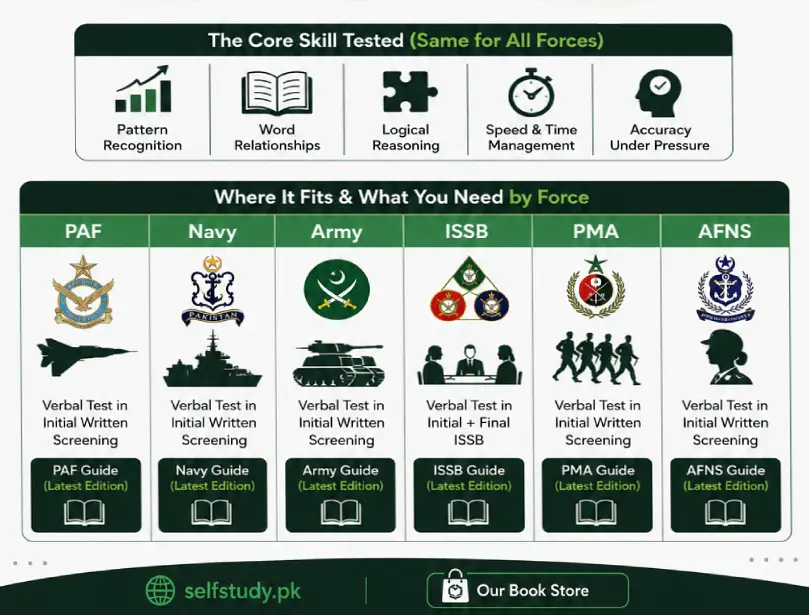
Verbal Intelligence Test by Force: PAF, Navy, Army, ISSB, PMA & AFNS
The core skill being testedβword-based pattern recognition under time pressureβis identical across every branch. What actually changes is where this test sits in your selection process and which guide covers your specific pipeline.
π‘ An Honest Note Before the Breakdown:
The core test format does not meaningfully change between forces. Do not trust any source claiming there is a secret “PAF-only” or “Navy-only” verbal format unless they can show you a verifiable difference. General practice applies to all.
Air Force
Pakistan Air Force (PAF)
The verbal intelligence test appears in PAF's initial computer-based test alongside the non-verbal and academic sections, same structure as the other forces. Practice the quizzes above, then work through our non-verbal intelligence test since PAF weighs both equally.
Navy
Pakistan Navy
Same core format as PAF and Army β verbal, non-verbal, and academic sections run together at the initial test stage before you're called for further assessment. There's no evidence of a Navy-specific verbal question style; general practice on this page covers it.
Army
Pakistan Army / PMA Long Course
Confirmed directly from our PMA Long Course guide: candidates take a computer-based initial test at their chosen AS&RC that includes the Verbal Intelligence Test and Non-Verbal Intelligence Test, plus a Verbal Reasoning Test, immediately followed by the academic test. Clearing this stage is what gets you called for the 4-day ISSB assessment β it happens before ISSB, not during it.
Assessment
ISSB
Here's a distinction most pages targeting "ISSB verbal intelligence test" get wrong: the written verbal and non-verbal papers are part of the initial/preliminary test at your recruiting center, not part of the 4-day ISSB assessment itself. ISSB proper focuses on GTO outdoor tasks, the interview, and psychological assessments β you have to clear the verbal/non-verbal gate first to be called there at all.
β‘ Sectional Gate
AFNS / AMC (Medical Cadre)
Confirmed from our AFNS Test Preparation Guide: the AFNS initial test runs Verbal Intelligence Test β Non-Verbal Intelligence Test β Academic Test in that exact order, and it's sectional β fail one, and your screen locks before you can attempt the next. AFNS verbal questions are described as "text-based logic puzzles, word associations, analogies, and series completions," designed to measure analytical reasoning rather than memorized knowledge. AMC (Army Medical College) candidates typically prepare against a similar pattern.
PMA Pipeline
Upcoming: PMA Long Course 158/159
If you're targeting PMA Long Course 158/159, the verbal intelligence test is one gate inside a longer pipeline β see the full PMA Long Course guide for eligibility, registration dates, and what happens after you clear the intelligence test.
To help you prepare for your specific branch, explore the exact pipelines below. Every preparation guide and bundle linked in the cards are the latest editions from Dogar Publishers, currently available at a discounted price.
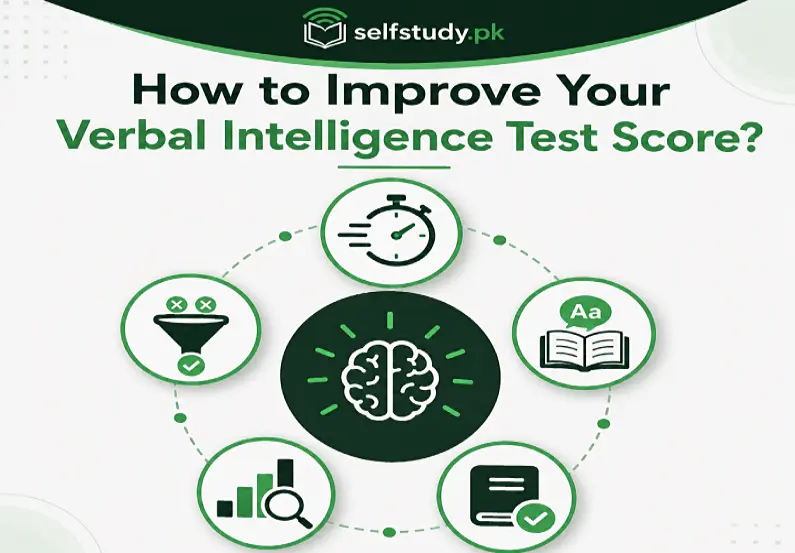
How to Improve Your Verbal Intelligence Test Score?
Passing this stage is not just about knowing the right answer; it is about finding it fast. Here is how to train effectively:
- β±οΈPractice under a timer, always. Untimed accuracy at home doesn’t transfer to a 20-second clock in the exam hall. Time every single practice session from day one.
- βοΈLearn to eliminate, not just solve. Ruling out two obviously wrong options first cuts your decision time in half, even when you cannot immediately spot the right answer.
- π§ Build vocabulary from patterns, not lists. Reading widely helps, but for this specific test, drilling analogy and synonym/antonym patterns from real past papers beats memorizing endless word lists.
- πTrack your wrong answers by category. If you are losing marks, find out whether it is series completion, coding-decoding, or something else specifically. Drill your weak category, don’t just study everything equally.
- πStudy grammar and comprehension basics. Reading comprehension and sentence-completion questions still show up in some papers, so keep your core grammar sharp even though this isn’t a dedicated language exam.
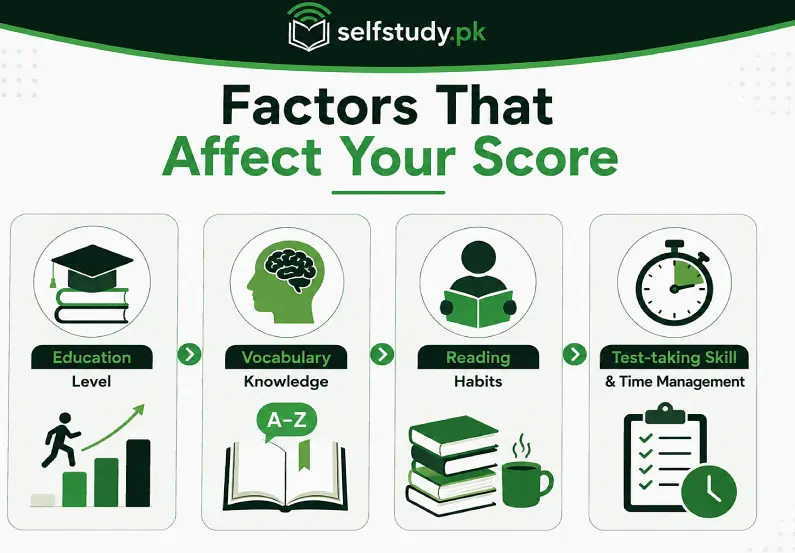
Factors That Affect Your Score
- π Education level. More exposure to reading and structured language tends to correlate with stronger pattern recognition on verbal sections.
- π§ Vocabulary knowledge. A wider vocabulary shortens the time it takes to process each question, which matters more than usual under a 20-second pace.
- π Reading habits. Regular readers process written patterns faster, which is most of what this test is actually measuring.
- β±οΈ Test-taking skill and time management. Even strong candidates lose marks to poor pacing β knowing when to skip and return to a question is a trainable skill, not talent.
FAQ's
A verbal intelligence test is a multiple-choice exam that checks your ability to solve problems using words, numbers, and letters. It includes questions like analogies, series completion, odd-one-out, and coding-decoding. It is a compulsory part of Pakistan’s armed forces initial tests (PMA, Navy, PAF, AFNS).
Common examples include:
- Completing a number series (2, 6, 12, 20, ?)
- Solving a word analogy (Pen is to Write as Knife is to ___)
- Spotting the odd word out in a group
- Decoding a hidden message using a letter-shift rule (You can find fully solved examples in the practice section above).
Verbal intelligence tests use words, numbers, and language-based logic. Non-verbal intelligence tests use shapes, diagrams, and visual patterns instead, without relying on language or reading ability at all.
- Use a timer: Practice under a strict time limit from day one.
- Drill your weaknesses: Focus specifically on the question types you get wrong, rather than studying everything equally.
- Use elimination: Quickly cross out the obviously wrong options to cut your decision time in half.
- Keep grammar sharp: Brush up on basic vocabulary and sentence structure.
The practical target is roughly 20 seconds per question. If you spend more than 30 seconds on a single question, consider it a warning sign that you are falling behind. Time management is critical.
This rule can change from year to year depending on the branch. We highly recommend checking your specific admit card or call letter instructions for the current negative marking policy before your test day.
Yes, the core question types and pacing are the same across all forces. What changes is when you take the test during the selection process. Check the force-by-force breakdown on this page for exact details.
Try to identify the pattern from the first three numbers before reading the rest of the sequence. Most patterns are simple addition, subtraction, or an alternating step. Daily timed practice is the only way to train your brain to spot these patterns fast enough.
Yes. All verbal intelligence MCQ practice on this page, including every analogy and series test, is completely free to use online.
No, not exactly. It is part of the initial/preliminary test at your recruiting center (AS&RC). You must clear this computer test before you can receive a call letter for the 4-day ISSB assessment. The 4-day ISSB focuses on GTO outdoor tasks, interviews, and psychological tests.
In simple terms, verbal intelligence is your mind’s ability to solve problems, reason, and understand concepts using words and language, rather than shapes or pictures.
Conclusion & Next Steps
Verbal intelligence test prep comes down to two things: knowing the five question types cold, and training yourself to solve them inside a 20-second window instead of at your own pace. Work through the analogy and series quizzes above, download the PDF for offline drilling, and check the force-specific notes if you're preparing for a particular board.
Have a question we haven't covered, or want a study plan for your specific test date? Reach out directly.