
PMA Long Course: Complete Guide (Registration, Eligibility, Test Dates, Call Letter, Result & Preparation)
If a friend, a cousin, or your own gut has told you to “apply for Long Course” and you don’t actually know what that means beyond “join the army,” this guide is written for exactly that starting point. By the end, you’ll know what the Long Course is, whether you qualify, how to apply, what ISSB has to do with any of it, and what happens on the other side if you’re recommended.
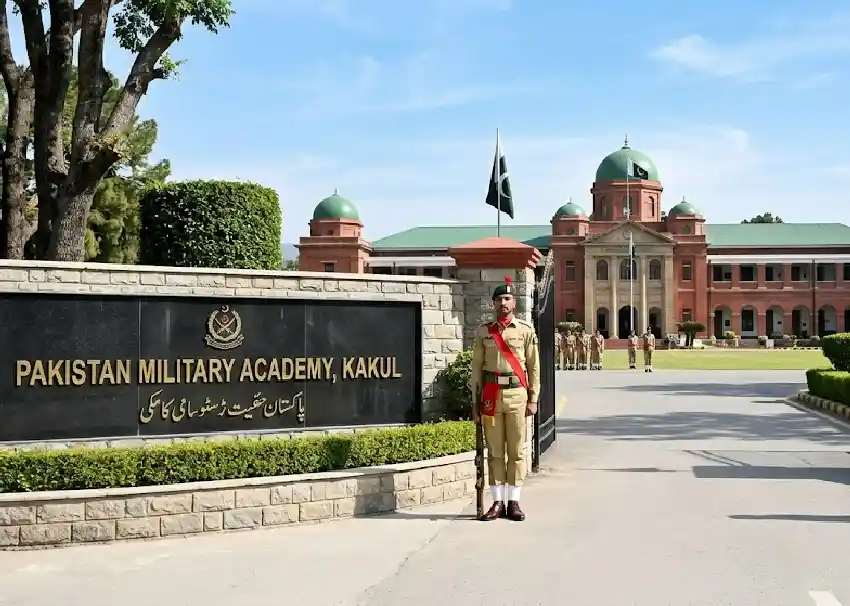
Quick Summary: The PMA Long Course is the Pakistan Army’s main direct-entry officer program at the Pakistan Military Academy (PMA) in Kakul, Abbottabad. It is open to unmarried male candidates who are 17–22 years old (up to 24–25 for graduates and serving soldiers) and have passed their Intermediate, A-Levels, or a bachelor’s degree. Candidates apply online at joinpakarmy.gov.pk, take an initial test and medical exam, and then go for the 4–5 day ISSB assessment. If recommended, they join PMA Kakul for two years of training before passing out as a Second Lieutenant. Right now in mid-2026, PMA Long Course 158 is currently in progress, and online registration for the next batch, PMA Long Course 159, is expected around September–October 2026.
Table of Contents
What Is PMA Long Course?
ISSB long course and ISSB PMA long course are the two most common terms students use when searching about this. Let’s look at it in simple words:
The PMA Long Course is the Pakistan Army’s main route for young men to become commissioned officers straight out of college, without needing a university degree first.
It is called a “Long Course” to distinguish it from the Graduate Course (which is a shorter program for candidates who already have a bachelor’s degree). If you are looking up things like “ISSB short course vs long course meaning” or “PMA long course age limits,” this table shows the exact difference:
Entry Type | Who It’s For | Approx. Training Length |
Long Course | Intermediate (FA/FSc) or A-Level holders, straight after college | 2 years |
Graduate Course | Candidates who already hold a bachelor’s degree | Shorter, since some foundational training overlaps with university education |
Each new batch is assigned a sequential number. The same institution has been running the “139th Long Course,” then 140th, 141st, and so on, one after another for decades. This is why you will see references to terms like ISSB 139 Long Course, ISSB 140, or PMA 142 scattered across old forums and search results—they are not different programs, just different batch years of the exact same course. As of mid-2026, PMA Long Course 158 is the batch currently going through registration and testing, with Course 159 expected to open registration around September–October 2026. Whatever number is “current” by the time you are reading this, the process described in this guide stays the same.
Every year, the Pakistan Military Academy (PMA) starts 2 new batches, and each batch is given a unique number (for example: 139, 140, 141, etc.). PMA has been running these courses one after another for decades. This is why you will see terms like ISSB 139 Long Course, ISSB 140, or PMA 142 scattered across old forums and search results. They are not different programs; they are just different batch numbers from previous years. As of mid-2026, PMA Long Course 158 is the batch currently going through testing, with Course 159 expected to open registration around September–October 2026. Whatever number is active when you read this, the selection process stays exactly the same.
❓ What is the Difference Between LC and LCC?
If you see the term “ISSB LC for girls” while searching online, it can be confusing. Here is the simple difference: LC stands for Long Course, and it is a male-only program (only boys can apply). It is completely different from the LCC, which stands for the Lady Cadet Course. Women who want to become army officers must apply through the separate LCC program, which has its own age limits, rules, and test dates.
👉 Are you a female candidate? Read our complete Lady Cadet Course (LCC) Guide
PMA Long Course Eligibility Criteria & Age Limit
This is the section you need to sit down and check carefully before you spend any time on the rest of the application process. If you are searching for terms like ISSB long course requirements, PMA selection rules, or age limits for graduates, this section covers all those basic rules:
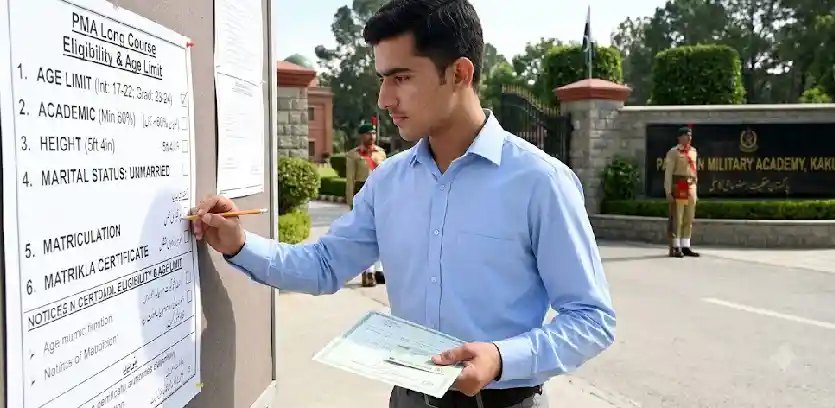
- Age Limit: Your age depends on your education level when you apply:
- For Intermediate (FA/FSc/A-Levels) students: You must be between 17 to 22 years old.
- For 2-year Bachelor’s degree holders: Up to 23 years old.
- For 4-year Bachelor’s degree holders (like BS/BBA): Up to 24 years old.
- For Serving Soldiers (men already working in the Army): Up to 25 years old.
(Note: Your age is calculated based on November 1 of the year you actually join the academy).
- Academic Qualification (Marks): You need to have passed your Intermediate exam with a minimum of 60% marks. However, the percentage rule is relaxed to 55% marks if you live in specific, underdeveloped areas (meaning your legal home address or domicile is in Balochistan, former FATA districts, Gilgit-Baltistan, Azad Kashmir, or remote parts of KPK, Sindh, and Punjab).
- Marital Status: Fresh candidates must be unmarried. If you are already a married soldier serving in the armed forces, you are only allowed to apply if you are over 20 years of age.
- Physical Standard (Height): You must be at least 5 feet 4 inches (162.5 cm) tall. Your weight must match your height according to standard medical fitness charts.
- Gender: Only male candidates can apply for this program, as mentioned earlier.
📋 PMA Long Course Eligibility Criteria & Age Limit
This is the section you need to sit down and check carefully before you spend any time on the rest of the application process. If you are searching for terms like ISSB long course requirements, PMA selection rules, or age limits for graduates, this section covers all those basic rules:
For beginners, understanding the timeline of how you go from an online form to entering the academy gates is crucial. You must pass each step in this exact order to move to the next one:
Online Registration
You apply online at the official recruitment website (joinpakarmy.gov.pk) when registration opens. During this setup, you will choose your nearest AS&RC (Army Selection and Recruitment Center—this is the local army office where your initial testing happens).
The Preliminary / Initial Test
You will go to your selected recruitment center to take a computer-based test. This includes a major Intelligence Test (split into a Verbal Intelligence Test and a Non-Verbal Intelligence Test covering different shapes and patterns) along with a Verbal Reasoning Test. Once you clear that, you will immediately sit for the Academic Test covering English, Math, Pakistan Studies, Islamiyat, and General Knowledge.
Initial Physical & Medical Screening
Right after passing the computer test, you must pass basic physical tasks at the selection center to check your stamina and strength. You have to hit these exact official targets:
- 1.6 KM Run: Complete 1 mile in 8 minutes or less.
- Push-ups: 15 repetitions within 2 minutes.
- Sit-ups: 20 repetitions within 2 minutes.
- Pull-ups: 3 successful chin-ups within 2 minutes.
- Ditch Crossing: Jump across a ditch that is 7 feet 4 inches wide.
Once you clear these tasks, you will undergo a basic medical checkup (height, weight, chest expansion, eyesight, and checking for flat feet or knocked knees) right at the center.
The ISSB 4-Day Test
If you pass all the initial stages, you will receive an official call letter to visit a specialized ISSB center. You will stay there for 4 to 5 days taking detailed written personality assessments, outdoor group tasks managed by a GTO (Group Testing Officer), and panel interviews.
Final Medical & GHQ Merit List
If the ISSB team recommends you, you must pass a complete, detailed medical exam at a MH (Military Hospital). Finally, GHQ (General Headquarters—the main army headquarters in Rawalpindi) prepares the final merit list of the top passing students who get to join the academy.
PMA Long Course Test Dates & Schedule
PMA Long Course follows the same two-intake-per-year pattern as the rest of Pakistan Army’s officer recruitment:
- Spring Cycle: Registration typically opens around March–April.
- Autumn Cycle: Registration typically opens around September–October.
Where Do the Initial & ISSB Tests Take Place?
1. Initial Preliminary Tests (At Your Chosen Local AS&RC)
When you fill out your online registration form, you must manually select your nearest AS&RC (Army Selection and Recruitment Center) from the options provided. Your generated Roll No Slip will display the exact date, time, and the local city center you chose. This is where your initial preliminary tests—including the computer-based testing, physical fitness trials, and basic medical checkups—take place.
2. The Main 4-Day ISSB Test (At Official Selection Centers)
While your initial preliminary tests are held at your chosen regional recruitment centers across the country, your main 4-day ISSB test will be conducted at one of the dedicated ISSB centers. For this advanced stage, the location is automatically assigned to you by the army based on your province. Candidates are distributed among these four official centers:
- Kohat (KPK)
- Gujranwala (Punjab)
- Malir / Karachi (Sindh)
- Quetta (Balochistan)
Your specific center and date will be printed on your official ISSB Call Letter.
PMA Long Course Call Letter & Status Check
Once you successfully pass your initial preliminary tests, your official ISSB Call Letter is generated online. Follow these exact steps to check your screening schedule and tracking panel details directly through the central selection board portal:
Understanding Your Status Results
When you run your verification profile, the system will instantly display one of these four distinct portal statuses:
Your specific testing batch layout has not been scheduled yet. Keep checking the portal weekly for scheduling updates.
You have been successfully chosen for the 4-day board evaluation phase, and your specific testing cycle is being finalized.
Your official call-up document is fully complete. It displays your exact arrival date, reporting time parameters, and your assigned selection center.
Your overall profile score did not meet the competitive merit cutoff threshold required for the current course intake.
 Important Note
Your final testing roll number is printed directly on this call letter. There is no separate “ISSB slip” to download.
PMA Long Course Result
PMA Long Course final results follow the official ISSB standard conference process. After your final evaluation day concludes at the selection center, your performance metrics are reviewed collectively by the board panel to issue an official assessment verdict:
(GTO, Psych & DP)
Recommended Candidates
Receiving this status means you have successfully cleared the central selection board's competitive parameters.
- Medical Phase: You proceed immediately to detailed final military medical checkups.
- GHQ Selection: Your profile moves onto the final selection merit list tracking at GHQ Rawalpindi before you receive final calls to join PMA Kakul.
Not Recommended
If you receive this status profile, it indicates your current score marks did not meet the competitive threshold limits for this term intake.
- Remain Eligible: Most fresh applicants do not lose attempts forever and are fully cleared to reapply.
- Next Try: You can apply for a future course number subject to matching the standard age limits and repeat-policy conditions in force.
Preparing for the PMA Long Course ISSB
ISSB stage is identical to preparing for any other ISSB stream. The exact same intelligence tests, Word Association Tests (WAT), Sentence Completion Tests (SCT), GTO group tasks (including group discussions and a lecturette on rotating general knowledge topics), and personal interviews apply regardless of which specific course number you are entering through.
Dogar Publishers remains the most widely used preparation book source for candidates across Pakistan. We go into full depth on selecting the right books, evaluating past-paper realism, and building a section-by-section preparation strategy in our comprehensive [Best ISSB Preparation Books guide] and our [ISSB Test: Process, Stages & Format guide].
Rather than repeating all of those testing strategies here, this guide focuses specifically on navigating the Long Course application and selection pipeline itself.
After ISSB: PMA Training and Commissioning
This is the part a lot of guides skip, and it's exactly the "what happens next" that a first-time applicant usually wants answered. Once you are recommended and cleared medically, your training journey begins:
1. Joining the Academy
You join the Pakistan Military Academy (PMA) in Kakul, Abbottabad (founded in 1947) for two years of training split into four six-month terms.
2. Academic & Field Training
Your training covers military knowledge, physical fitness, weapons handling, and leadership exercises. Cadets are organized by battalion and company (PMA's companies are traditionally named after Islamic historical figures).
3. Passing Out Parade (POP)
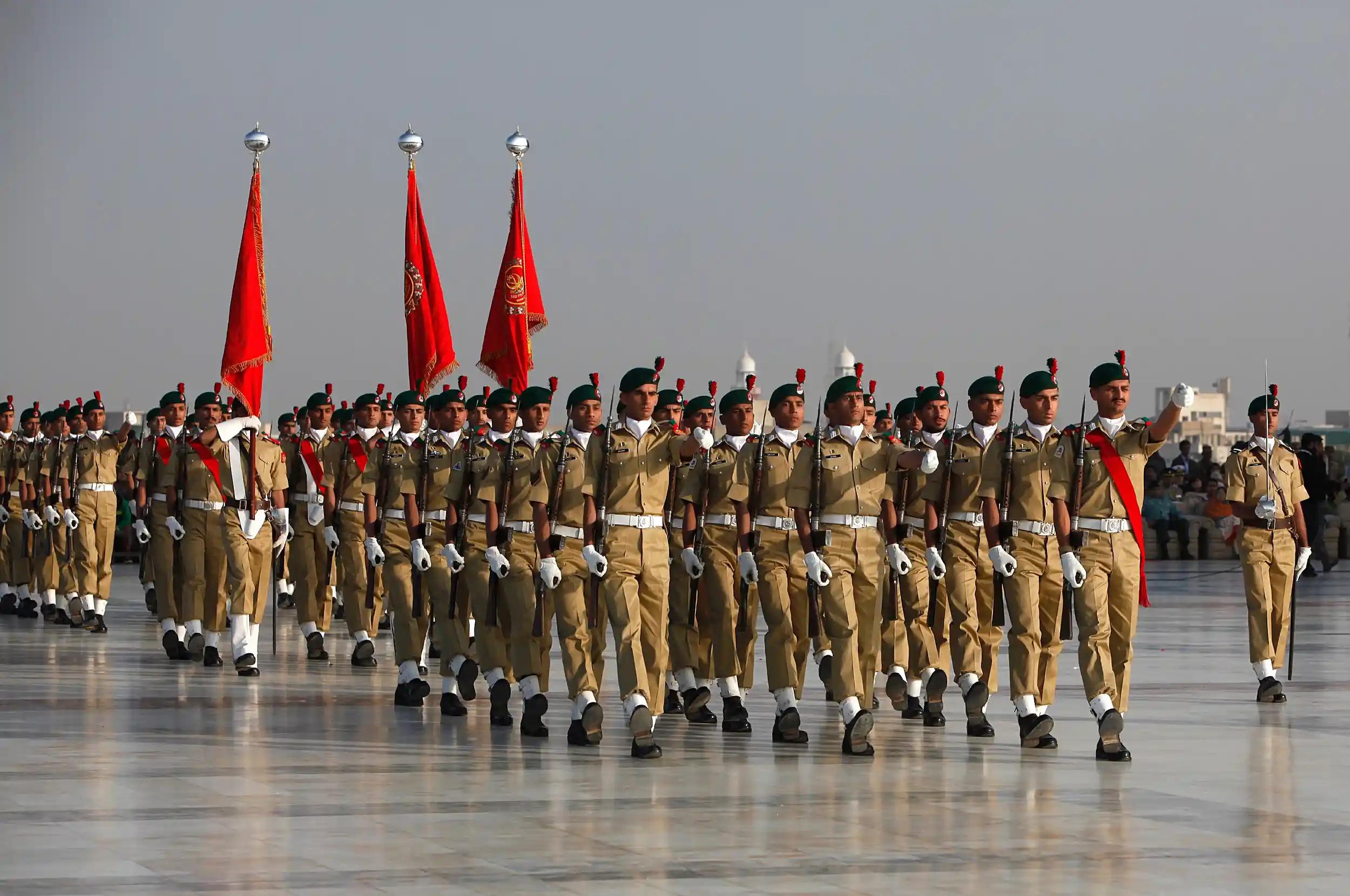
At the end of the two years, cadets take part in the Passing Out Parade. This is the formal ceremony marking your commissioning as a Second Lieutenant, and it is one of the most-attended military ceremonies in Pakistan.
4. Active Service Deployment
From there, newly commissioned officers are posted directly to their first active unit and begin their official active duty service.
Official Information vs. Social Media
Unofficial Facebook pages and forwarded images (call letter screenshots, "leaked" schedules, and similar) circulate widely around every new course number, but none of them are official ISSB or Pakistan Army channels.
For anything that affects your actual application — dates, eligibility, documents — the only two sources that matter are:
If you're looking for the official notification in PDF form, that's also published directly on joinpakarmy.gov.pk under the relevant course's advertisement, not through a third party.
Frequently Asked Questions
Pakistan Army’s main direct-entry officer commissioning program at the Pakistan Military Academy, Kakul, for unmarried male candidates who’ve completed Intermediate/A-Levels or a bachelor’s degree. It leads to a commission as a Second Lieutenant after two years of training.
As of mid-2026, Course 158 is the batch in process, with Course 159 expected to open registration around September–October 2026. Always confirm the exact current number on joinpakarmy.gov.pk, since a new course is announced roughly every six months.
Roughly 17–22 for Intermediate/A-Level candidates, extending up to 24–25 for bachelor’s degree holders and serving soldiers, depending on the specific route. Confirm exact brackets for your course on joinpakarmy.gov.pk.
No. It’s a male-only entry scheme. Women apply through the separate Lady Cadet Course (LCC), which has its own eligibility criteria and process.
Two years, split into four six-month terms, at PMA Kakul.
Online, at the official Pakistan Army recruitment portal, joinpakarmy.gov.pk.
