
What Is ISSB? Full Form, Meaning and Complete Guide for Pakistani Students
If you are planning to join the Pakistan Army, Navy or Air Force as an officer, you will hear the word ISSB again and again. Every recruitment advertisement mentions it. Every senior who got selected talks about it. But most students never get a clear, simple answer to the basic question. What is ISSB actually?
At SelfStudy PK, we work with ISSB candidates every day. In this guide we explain what ISSB means, how it started, how the test actually works, and which forces use it. We wrote this so you do not have to open ten different websites to understand one topic.
ISSB stands for Inter Services Selection Board. It is the official body that selects officers for the Pakistan Army, Pakistan Navy and Pakistan Air Force.
ISSB is not an exam in the normal sense. It is a four day assessment where psychologists, Group Testing Officers and a President or Deputy President judge a candidate's personality, intelligence and leadership qualities. A candidate can only join as a commissioned officer after ISSB recommends them.
ISSB Full Form, Meaning, and Urdu Translation
ISSB stands for Inter Services Selection Board (abbreviation: ISSB). The word “Inter Services” is the important part. It means the board does not belong to one single force. It works for all three services together, the Army, the Navy and the Air Force.
This is why the same ISSB process is used whether you are applying for Pakistan Military Academy, Pakistan Navy or Pakistan Air Force. The uniform changes. The board does not.
ISSB is also sometimes written as issb.com or searched as “issb pakistan” by students who are not sure if it is a Pakistan specific body or an international one. To be clear, ISSB in this context is a Pakistani institution. It has no connection to any similarly named body outside Pakistan.
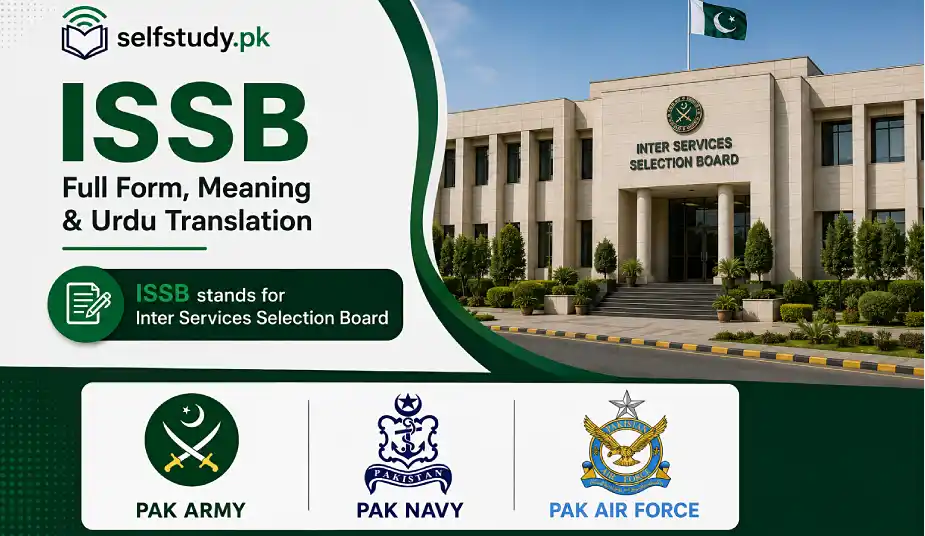
What Is the Meaning of ISSB in Urdu? (ISSB Meaning in Urdu)
In Urdu, ISSB (Inter Services Selection Board) is written as انٹر سروسز سلیکشن بورڈ (مسلح افواج کا انتخابی بورڈ). It simply means the joint selection board for Pakistan’s armed forces.
ISSB vs CSS: What Is the Difference?
A common question candidates ask is the difference between ISSB and CSS. Unlike CSS (Central Superior Services), which selects civil servants and bureaucrats for government ministries, ISSB exclusively selects commissioned military officers for Pakistan’s armed forces.
Why Is It Called “Inter Services”?
Here is something most guides never explain properly, and it genuinely confuses a lot of first time candidates.
Students often think Army ISSB, Navy ISSB and PAF ISSB are three separate boards with three separate testing methods. They are not. ISSB is one single board. The same four day process, the same three assessors and the same evaluation method are used no matter which force you are applying to.
What actually changes between forces is the entry scheme, the age limit, the education requirement and the medical standard set by that particular force. ISSB itself simply measures whether you have the mental, social and physical qualities needed to be an officer. Once ISSB recommends you, your own service, Army, Navy or PAF, decides your final commission based on your merit position and vacancies.
This single fact clears up a huge number of confused searches we see from students, things like “is ISSB for PAF and Pak Army the same” or “difference between ISSB and AHQ SSB test.” The answer is simple. There is one ISSB. The entry scheme around it is what changes.
History of ISSB
ISSB has a longer history than most students realise, and knowing it helps you understand why the process looks the way it does today.
At the time of independence in 1947, Pakistan inherited three separate services selection boards from British India. In 1952 these three boards were combined into one single Inter Services Selection Board.
ISSB started functioning in Lahore. It was later moved to Kohat, where it was set up in the old Park Lane Hotel building. Kohat remains the headquarters of ISSB to this day.
As the number of candidates grew, more centres were opened to handle the load:
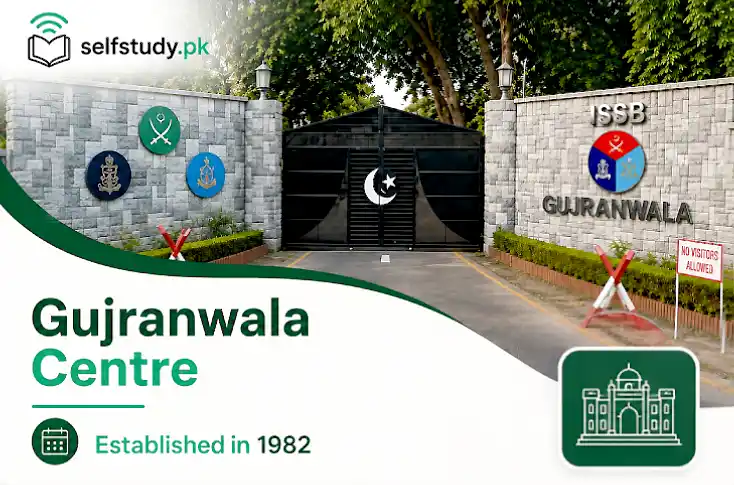
Gujranwala Centre
Established in 1982
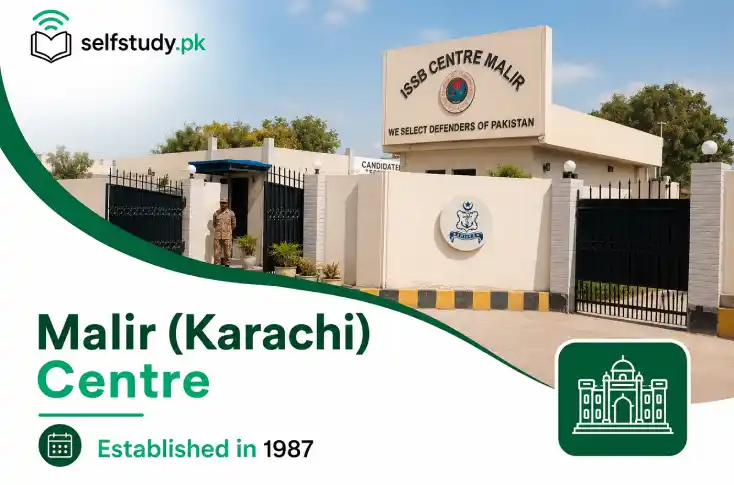
Malir (Karachi) Centre
Established in 1987
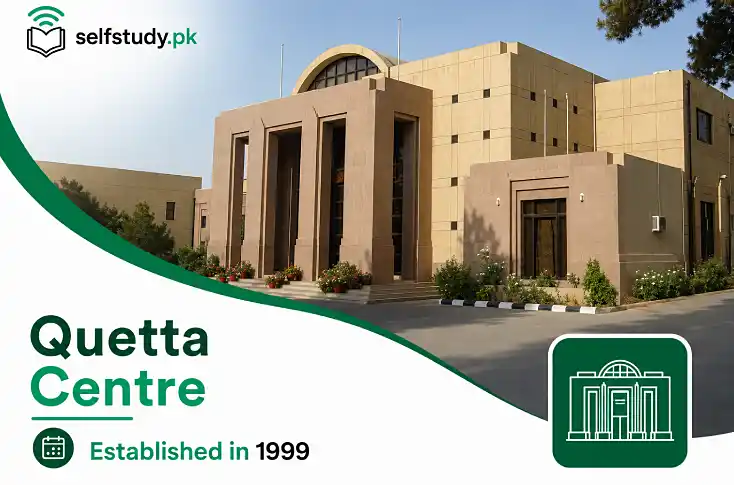
Quetta Centre
Established in 1999
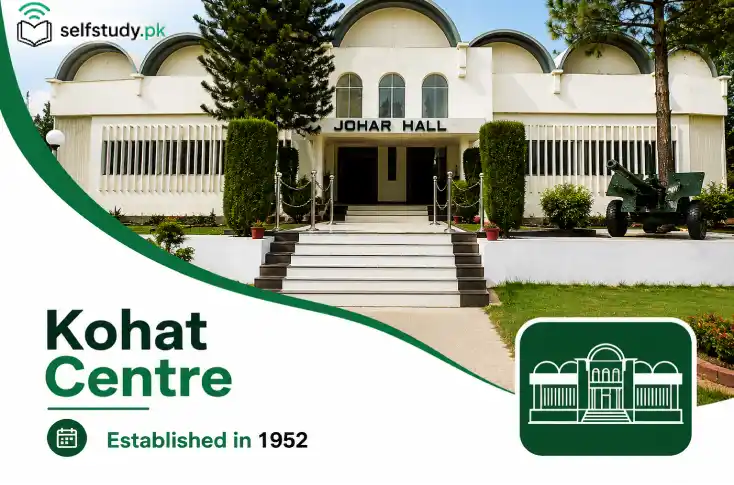
Kohat Centre
Established in 1952
Today, all four centres, Kohat, Gujranwala, Malir and Quetta, run the same standard ISSB process. Kohat also handles ISSB Quetta related queries directly, since Quetta operates under Kohat’s administration for candidate correspondence.
Which Forces and Entry Schemes Use ISSB
Since ISSB is a shared board, it is used across many different entry routes into Pakistan's armed forces. Here are the main ones.
Pakistan Army
Pakistan Army uses ISSB for its officer entry schemes, including the Long Course at Pakistan Military Academy, Direct Short Service Commission (DSSC), the Technical Cadet Course (TCC), the Lady Cadet Course (LCC) and AFNS for nursing officers. We cover the general Army process in detail on our Army ISSB guide.
Pakistan Navy
Pakistan Navy uses ISSB to select PN Cadets and Short Service Commission officers. Our Navy ISSB guide explains the navy specific parts of the process.
Pakistan Air Force
Pakistan Air Force uses ISSB for General Duty Pilot, Aeronautical Engineering and other commissioned officer branches. See our PAF ISSB guide for the details specific to the air force.
Featured Army Schemes
Within the Army route, two schemes deserve special mention because so many students search for them directly. The PMA Long Course is the main route into Pakistan Military Academy Kakul and leads to a full career Permanent Commission. We explain this route on our PMA ISSB guide, and if you want the exact eligibility criteria, registration dates and syllabus for the current course, our detailed PMA Long Course 159 guide covers that separately.
The Technical Cadet Course (TCC) is a unique scheme where selected candidates study engineering at NUST while receiving military training, then get commissioned as a Captain in a technical corps after graduation. We explain how this works on our TCC ISSB guide.
Female Candidates
For candidates specifically looking at Army entry through the female only routes, the Lady Cadet Course guide and the AFNS guide explain eligibility and process for those schemes in full.
The Complete ISSB Selection Process
ISSB runs a structured four day evaluation. The exact internal naming can vary slightly by source, but the sequence below matches how ISSB's own selection system describes it, and how it consistently plays out at Kohat, Gujranwala, Malir and Quetta.
Day One: Reporting, Screening, and Initial Testing
Candidates report to the ISSB centre and are briefed on the schedule. On this day, candidates sit the Verbal and Non Verbal Intelligence Test, mechanical aptitude test, and the Picture Perception and Discussion Test (PPDT). These tests screen candidates for basic mental ability and situational judgement. Your reporting date itself comes from your call letter, not a public calendar. We explain both of these in full on our ISSB Test Dates guide and our ISSB Call Letter guide.
Some candidates are screened out at this stage and sent home. This screen out mechanic is not a punishment. It simply means the board decided, based on this initial screening test alone, that the candidate's profile does not match what is needed for further testing on this attempt.
Day Two: Psychological Tests Begin
Candidates who are not screened out move into the psychological testing phase, run by ISSB psychologists. This includes personality tests like Word Association Tests (WAT), Sentence Completion Tests (SCT), Situation Reaction Tests (SRT), and thematic apperception tests. These are designed to reveal personality traits, motivation and thought patterns that a short interview alone cannot show. Interviews with the President or Deputy President typically begin around this stage as well and continue in parallel across the following days.
Day Three and Four: GTO Tasks
The Group Testing Officer (GTO) phase is what most people picture when they think of ISSB. It is a set of individual and group outdoor activities that reveal how a candidate behaves under pressure, plans in a team, and takes initiative. Common GTO tasks include the Group Discussion, Group Planning Exercise, Progressive Group Task, Half Group Task, Command Task, Lecturette, Individual Obstacles and the Final Group Task.
Unlike a classroom exam, there is no single correct answer here. The GTO is watching how you cooperate, lead and solve problems as a team, not just whether the team finishes the task.
Final Day: Conference and Result
On the last day, the psychologist, the GTO and the President or Deputy President sit together in a conference. Each assessor shares their independent observation of every candidate. Only when all three domains agree that a candidate meets the required standard is that candidate recommended.
This is why a candidate can do very well in the interview but still not get recommended. ISSB does not rely on one person's opinion. It requires agreement across three separate, independently gathered assessments.
The Intelligence Test and Psychological Tests in ISSB
The very first hurdle in ISSB, the Intelligence Test on day one, is built almost entirely on verbal and non verbal reasoning questions. This includes analogies, series completion, coding and decoding, odd one out questions and picture based reasoning.
This is exactly where most candidates lose marks without realising it, simply because they have never practised this exact question style before walking into the test hall. Doing a handful of general IQ questions from an old book is not the same as training on the specific formats ISSB actually uses under real time pressure.
We built dedicated practice pages for exactly this reason. Our practice material covers both question types together, with full explanations and timed practice sets modelled on the real ISSB format.
👉 Worried about the intelligence test screening you out on day one? Practice the exact question types ISSB uses. Start with our Verbal and Non Verbal Intelligence Test guide today.
If you want to focus on one question type at a time, our Verbal Intelligence Test page drills analogies and series questions, while our Non Verbal Intelligence Test page covers odd one out and pattern based questions in depth.
Official ISSB Website and Avoiding Confusion
The current official website of ISSB is issb.gov.pk. This is the .gov.pk government domain, which is the correct one to trust for anything official.
You will still see a lot of old content online referencing issb.com.pk. This was used in the past and still appears in a huge number of older search results, forum posts and outdated guides. If you are checking anything time sensitive like a call letter or a result, always confirm you are on the current official issb.gov.pk domain, since old bookmarks and old blog links can point you to an outdated address.
For force specific applications, remember that ISSB itself does not run your original registration. That happens through your specific service portal, for example joinpakarmy.gov.pk for Army entries, joinpaknavy.gov.pk for Navy entries, and joinpaf.gov.pk for Air Force entries. ISSB only takes over once your application has been shortlisted and you are called for testing.
ISSB Centre Locations
ISSB currently runs full testing at four centres across Pakistan.
| Centre | Location / Station | Coverage Area |
| Kohat | ISSB Kohat Cantt, KPK (Est. 1952) | KPK, Gilgit-Baltistan, AJK & Upper Punjab |
| Gujranwala | Rahwali Cantt, Gujranwala, Punjab (Est. 1982) | Central & Southern Punjab |
| Malir (Karachi) | Malir Cantt, Karachi, Sindh (Est. 1987) | Sindh & Southern Region |
| Quetta | Quetta Cantt, Balochistan (Est. 1999) | Balochistan (Administered through Kohat HQ |
Which centre you are called to usually depends on your home region and the entry scheme you applied through, not something you get to choose yourself.
Is ISSB Difficult? What “Recommended” Actually Means
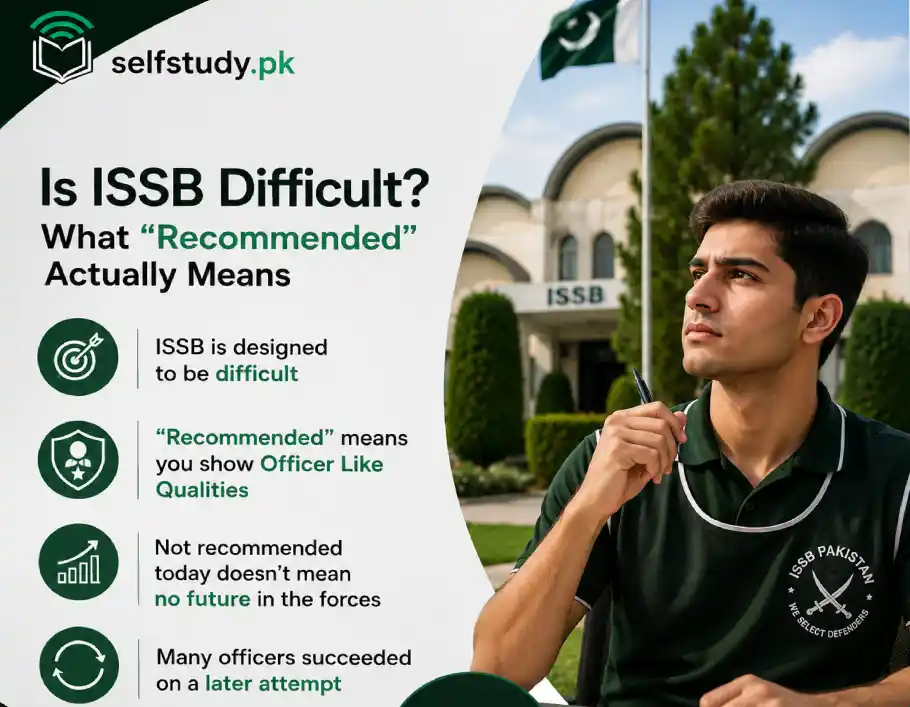
Yes, ISSB is genuinely difficult, and it is meant to be. The pass rate is intentionally low because the board is not testing knowledge you can memorise the night before. It is testing consistent personality traits and decision making built over years.
Being “recommended” by ISSB means the board has judged, across all three domains together, that you currently show the Officer Like Qualities the forces are looking for. Being screened out or not recommended does not mean you have no future in the forces. A large number of officers serving today were not recommended on their first attempt and were successful on a later one after working on specific weak areas identified during their first ISSB.
How to Prepare for ISSB
Core principles that apply regardless of your targeting scheme or branch.
Practice Real Intelligence Test Formats
Practice the intelligence test format specifically, not just generic IQ questions. Our Verbal and Non Verbal Intelligence Test page is built around the actual ISSB format.
Start Practice Tests →Work on Physical Fitness Early
GTO tasks are physically demanding, and being out of breath affects your judgement and confidence during outdoor tasks.
Read Newspapers & Current Affairs
Read newspapers and stay aware of current affairs. Group discussions and lecturette topics often come from real world events.
Be Consistent, Not Rehearsed
Be consistent, not rehearsed. Psychologists and GTOs are specifically trained to notice answers that sound memorised rather than genuine.
Frequently Asked Questions
ISSB stands for Inter Services Selection Board, the body that selects officers for the Pakistan Army, Navy and Air Force.
In Urdu, ISSB is written as انٹر سروسز سلیکشن بورڈ (مسلح افواج کا انتخابی بورڈ), meaning the combined selection board for the armed forces.
ISSB selects military officers for the Pakistan Army, Navy, and Air Force. CSS selects civil servants and bureaucrats for government administrative service.
Yes. ISSB is one single board used by all three services. The entry scheme, age limit and eligibility rules differ by force, but the ISSB process itself is the same.
Pakistan inherited three separate services selection boards in 1947. These were combined into the single Inter Services Selection Board in 1952. It later moved from Lahore to its current headquarters in Kohat.
ISSB runs a four day process. Day one covers intelligence testing and screening (PPDT). Psychological testing and interviews follow. The final two days cover GTO tasks, and the last day is the assessment conference where the result is decided.
Screen out refers to candidates who do not pass the day one initial screening (Intelligence Test and PPDT) and are sent home before psychological and GTO testing begin.
The current official website is issb.gov.pk. Older content referencing issb.com.pk should not be trusted for anything time sensitive.
Yes, within the attempt limit set by the specific entry scheme. Many currently serving officers were not recommended on their first attempt.
ISSB currently operates centres at Kohat, Gujranwala, Malir and Quetta. Kohat is the headquarters.
