
What Is Army ISSB? Complete Guide for Pakistan Army Entry
If you search “army issb,” you will find dozens of pages that just repeat the general ISSB process and call it done. That is not enough. The real question most candidates actually have is different. It is which Army entry scheme should I apply through, and does ISSB work differently for each one.
At SelfStudy PK we work with Army aspirants applying through every route, Long Course, DSSC, TCC and LCC. In this guide we explain what Army ISSB actually means, and how the entry scheme you pick, not ISSB itself, decides your age limit and eligibility.
Army ISSB refers to the Inter Services Selection Board process used to select Pakistan Army officers. The evaluation itself is identical across all entry schemes (including PMA Long Course, Direct Short Service Commission (DSSC), Technical Cadet Course (TCC), and Lady Cadet Course (LCC)). What changes between schemes is your age limit, educational requirements, and final commission.
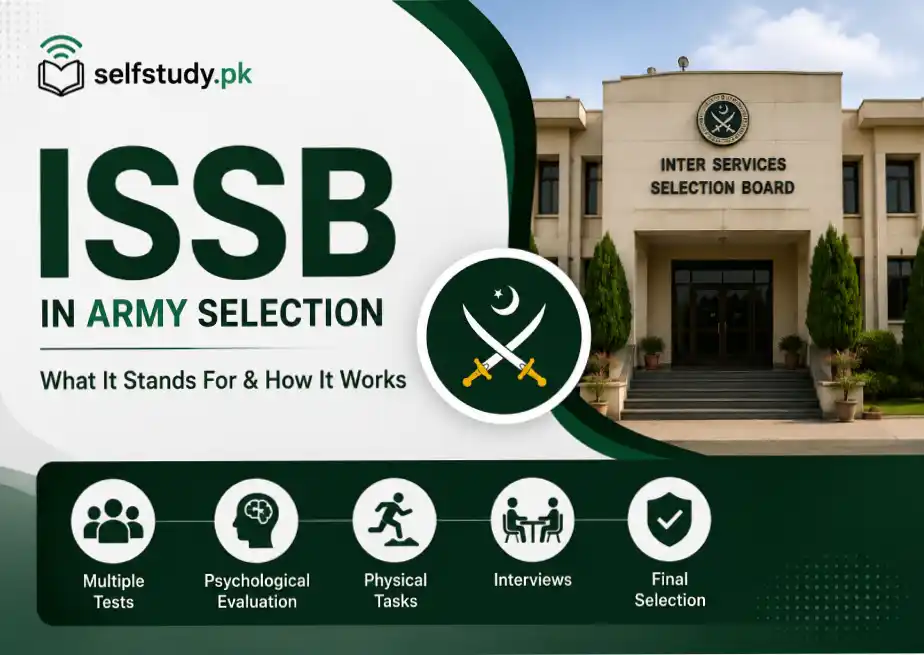
WHAT ISSB STANDS FOR IN ARMY & HOW IT WORKS
If you are wondering what issb stands for in army selection, it stands for the Inter Services Selection Board.
A common misconception is that Army ISSB is a separate or easier version of the test. It is not. It is the exact same four-day evaluation run by the same central board that selects officers for the Pakistan Navy and Air Force.
If you are looking for a complete, tri-service breakdown of how the four days work step-by-step, visit our main guide on what is ISSB.
What candidates usually mean when searching for what is issb in army selection is simpler than they realize: they want to know how to become a commissioned Pakistan Army officer, and ISSB is one mandatory milestone in that broader journey.
The One Thing Most Guides Get Wrong About Pak Army ISSB
The most common confusion among Army candidates is assuming that ISSB sets the age limit, or that ISSB is harder for one entry scheme than another. Neither is true.
ISSB measures three core pillars for every candidate: intelligence, personality traits, and outdoor leadership (GTO tasks). The entry scheme you apply through is what actually sets:
- Your maximum age limit
- Your required educational qualifications (FSc vs. Bachelor’s/Master’s)
- Your final commission (Permanent Commission vs. Short Service Commission)
Entry Schemes Into Pakistan Army Through ISSB
Here is a clear breakdown of the primary entry routes into the Pakistan Army that utilize ISSB as their main officer selection phase.
PMA Long Course
Permanent CommissionThis is the primary route into the Pakistan Military Academy (PMA) Kakul. It is a two-year training course leading to a full-career Permanent Commission starting as a Second Lieutenant.
📌 We explain this scheme fully on our PMA ISSB guide. For current eligibility criteria, age limits, and course registration dates, see our detailed PMA Long Course 159 guide.
Direct Short Service Commission (DSSC)
Specialist GraduatesDSSC is designed for graduate specialists in fields like the Army Education Corps (AEC), Judge Advocate General (JAG / Law), Information Technology, RV&FC, and Psychology. Age limits extend up to 28 years for civilian graduates.
📌 DSSC leads to a Short Service Commission rather than a lifetime career, though extensions and conversions to permanent commissions exist based on performance requirements.
Technical Cadet Course (TCC)
FSc Pre-EngineeringOpen exclusively to male FSc Pre-Engineering students. Selected candidates study engineering at NUST under military sponsorship, followed by 1 year of military training at PMA Kakul. Upon completion, candidates are commissioned as a Captain—a higher starting rank than the Second Lieutenant rank granted through the Long Course.
📌 Learn more on our TCC ISSB guide.
Lady Cadet Course (LCC)
Female GraduatesLCC is the primary entry route for female graduates looking to join the Pakistan Army as commissioned officers across technical and professional branches like ICT, Signals, Engineering, and Education.
📌 Eligibility criteria and step-by-step registration details are covered in our Lady Cadet Course guide.
HOW ARMY ISSB SELECTION WORKS
Because Army ISSB uses the standard Inter Services evaluation layout, the general testing flow spans four days:
Day 1
Reporting, documentation, Verbal/Non-Verbal Intelligence Test, Mechanical Aptitude, and Picture Perception & Discussion Test (PPDT).
Day 2
Psychological tests (WAT, SCT, SRT, TAT) and initial interviews with the President/Deputy President.
Day 3 & 4
Outdoor Group Testing Officer (GTO) tasks, group discussions, command tasks, and individual obstacles.
Final Day
Final conference where the Psychologist, GTO, and President synthesize their observations to grant a "Recommended" or "Not Recommended" status.
➔ For a complete, day-by-day walkthrough of the testing schedule, read our complete ISSB process guide.
➔ Once your date is confirmed, check our Army ISSB Call Letter guide for status updates.
AGE LIMIT & EDUCATIONAL REQUIREMENTS BY SCHEME
Treat the figures below as a general reference. Always confirm exact requirements against the latest advertisement published on joinpakarmy.gov.pk.
| Scheme | Typical Age Range | Educational Requirement |
| PMA Long Course | 17 to 22 years (up to 24–25 for specific regions) | Intermediate / FSc (Min 60%, 55% for specified regions) |
| DSSC | Up to 28 years for civilian graduates | Relevant BS / Master’s degree depending on branch |
| TCC | 17 to 21 years | FSc Pre-Engineering (Min 65%, Physics, Maths, Chem/CS) |
| LCC | Set per advertisement branch | Relevant BS / Qualifications by branch |
| AFNS | 17 to 25 years (BSc Nursing route) | FSc Pre-Medical (Min 50–55% depending on course entry) |
For full issb pak army requirements and attempt-limit rules, visit our Army ISSB Eligibility Criteria guide.
The Intelligence Test in Army ISSB
No matter which Army scheme you apply through, the first real hurdle is the same. Day one of ISSB opens with an intelligence test built on verbal and non verbal reasoning, followed by the Picture Perception and Discussion Test. Candidates who struggle here are screened out before they even reach the psychological or GTO stages, regardless of how strong their application looked on paper.
This is the exact area where focused practice pays off fastest, because unlike personality traits, reasoning speed genuinely improves with repetition on the right question formats.
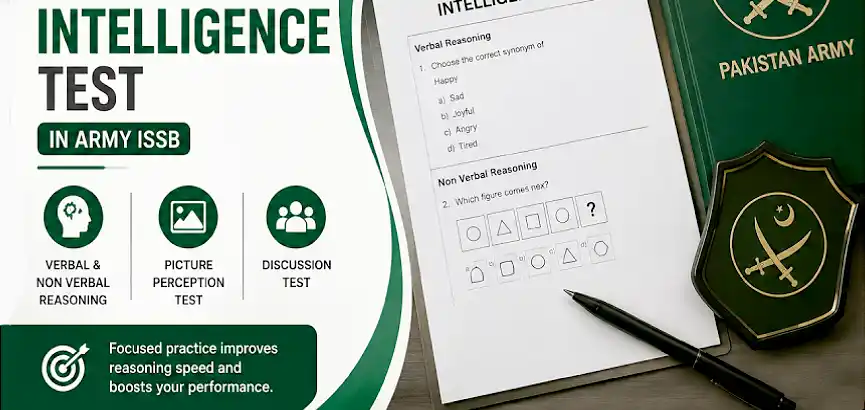
Don't let the intelligence test screen you out before you even reach the interview. Practice the exact formats ISSB uses on our Verbal and Non-Verbal Intelligence Test page.
If you already know which side needs more work, our Verbal Intelligence Test page focuses on analogies and series questions, and our Non-Verbal Intelligence Test page focuses on pattern and odd-one-out questions.

Common Myths About Army ISSB
"ISSB is easier for DSSC than for Long Course."
Not true. The evaluation standard is the same. What differs is the age and education profile of the candidates applying, not the difficulty of the test itself.
"If I fail once, I can never join the Army again."
Not true for most schemes. Each entry scheme sets its own limit on how many times you can attempt ISSB, and it is usually more than one attempt.
"Army ISSB and Air Force ISSB use different assessors."
Not true. The Psychologist, GTO and President or Deputy President structure is identical across all three forces, since it is the same Inter Services Selection Board running it.
Frequently Asked Questions
Army ISSB refers to the Inter Services Selection Board assessment used to select commissioned officers for the Pakistan Army.
Yes. In fact, ISSB is the exact same joint board for all three branches—Pakistan Army, Pakistan Navy, and Pakistan Air Force. The core 4-day board evaluation, including psychological tests, GTO tasks, and interview procedures, is completely identical regardless of which force you apply to. Only the preliminary AS&RC screening exams, branch-specific academic papers, and final medical standards differ.
Yes. Appearing in issb pak army is a necessary step for minority (including Christian) candidates in Punjab seeking a commissioned officer role. Reserved quotas exist, but clearing the ISSB selection board remains mandatory.
TCC candidates are commissioned as Captain after completing their engineering degree at NUST and one year of military training at PMA Kakul, which is a higher starting rank than the Second Lieutenant rank given through the PMA Long Course.
No, AFNS (Armed Forces Nursing Service) candidates do not undergo the 4-day ISSB process. Instead, after clearing the initial computer test and medical at AS&RC, selected candidates appear before the GHQ Selection Board interview.
The PMA Long Course leads to a Permanent Commission (a full lifetime career). Schemes like DSSC generally lead to a Short Service Commission, though extensions and conversions are possible.
